
NBA Quarter and Half-Time Betting in the UK: Period Markets, Scoring Patterns and Value
 Available in US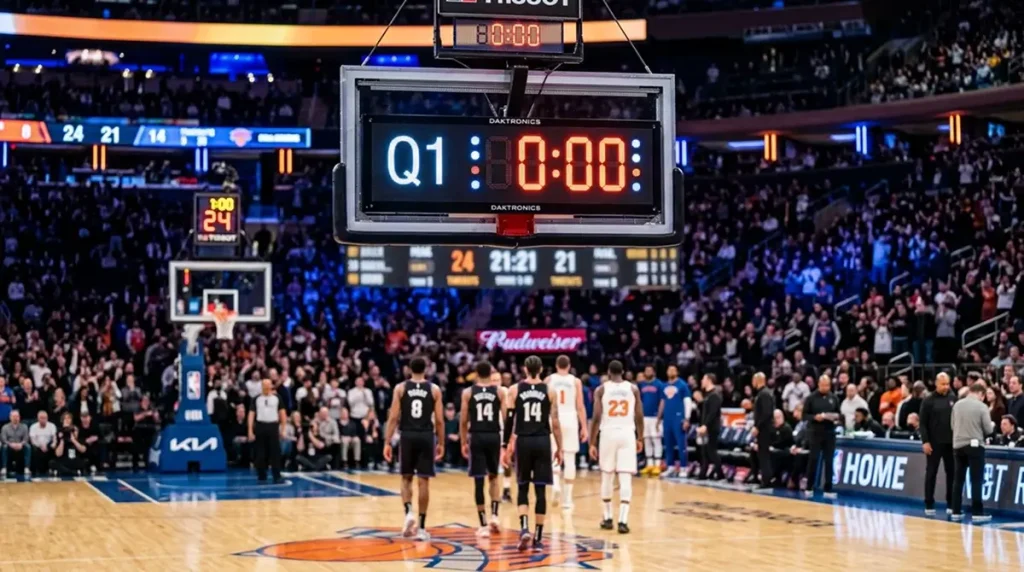
Contents
Period Markets Let You Bet Specific Phases of an NBA Game
Most NBA bettors see a game as one event: 48 minutes, one result. I used to think the same way until I started charting scoring patterns by quarter and realised that a single NBA game is really four distinct contests with different dynamics, different rotations, and different levels of intensity. Quarter and half-time markets let you bet on those individual phases, and the pricing is often softer than full-game lines because fewer bettors and less sharp money flow into them.
Period betting splits the game into its natural segments: first quarter, second quarter, first half, third quarter, fourth quarter, and second half. For each period, the bookmaker offers a spread (which team wins that period by how many points), a total (combined points in that period), and sometimes a moneyline (which team wins that period outright). Around 290 million online bets are placed monthly across UK sportsbooks, and period markets represent a small but growing fraction of that volume — small enough that the odds are not always as precisely set as full-game lines.
See also NBA player props for in-game betting markets.
Quarter Spreads and Quarter Totals
A quarter spread works identically to a full-game spread, just compressed into twelve minutes of play. If the first-quarter spread is -1.5 in favour of the home team, they need to outscore the opponent by two or more points in that quarter for the bet to win. Quarter totals set a number for combined scoring in a single period — typically between 52 and 60 points for a standard NBA quarter — and you bet over or under.
The maths behind quarter totals is interesting because scoring in the NBA is not distributed evenly across four periods. Teams score differently in the first quarter than in the fourth, and understanding that distribution is the foundation of quarter betting value. A full-game total of 228 does not mean four quarters of 57 points each. The first quarter typically accounts for roughly 24 to 25 per cent of total scoring, the second quarter 25 to 26 per cent, the third quarter 24 to 25 per cent, and the fourth quarter 25 to 27 per cent. That imbalance is where the opportunities live.
First-quarter unders are a reliable angle I have tracked across multiple seasons. Starters tend to feel out the opponent early, defensive intensity is at its highest (players are fresh and focused), and teams use their opening possessions to establish game plans rather than freelance. The result is a first quarter that frequently finishes under the bookmaker’s total. By contrast, fourth quarters are more volatile — garbage time in blowouts suppresses scoring, while close games push it higher — which makes fourth-quarter totals harder to predict but occasionally underpriced in specific situations.
Scoring Distribution Across NBA Quarters
The average NBA game in the 2026-26 season saw teams scoring at a pace that produced regular-season per-game averages above 112 points. Distributing that scoring across quarters reveals patterns that quarter bettors can exploit. Third quarters have a distinctive characteristic: the team that trailed at half-time often comes out with adjusted tactics and heightened intensity, while the leading team sometimes coasts. This “third-quarter adjustment” effect means the underdog wins the third quarter outright more often than any other period.
I track third-quarter moneylines specifically for this reason. If a team is a clear full-game underdog but has a coaching staff known for strong half-time adjustments, the third-quarter moneyline can offer value that the full-game price does not. The bookmaker sets third-quarter lines partly from the full-game price and partly from quarter-specific modelling, but the data feeding those models is noisier than full-game data because the sample sizes are smaller and the variance is higher. That noise works in your favour if you have a thesis about how a specific matchup will unfold in the second half.
Second-half betting is worth mentioning separately because it captures both the third and fourth quarters in one wager. The advantage here is that second-half lines often open at tip-off based on the pre-game full-game line, and they do not fully adjust for first-half performance until the actual half-time break. If the first half plays out in a way that changes the game’s dynamics — a star player in foul trouble, a shooting hot streak that is unlikely to sustain — the second-half line at the break can be mispriced relative to what you expect from the remaining 24 minutes.
Why Overtime Never Counts in Period Bets
This is the single most important rule in quarter and half-time betting, and misunderstanding it has cost bettors real money. Period bets settle on regulation time only. If you bet the fourth-quarter total over 56.5 and the fourth quarter ends 54-54 (combined 108 from both teams for a 54-per-side score is not how it works — let me clarify). The fourth-quarter total counts only the points scored in the twelve minutes of the fourth quarter. If the game then goes to overtime, the overtime points do not get added to the fourth-quarter total or the second-half total. Your bet settles on the fourth-quarter score alone.
This rule also applies to fourth-quarter and second-half spreads. If the game is tied at the end of regulation and goes to overtime, the fourth-quarter and second-half spreads settle on the score at the end of the fourth quarter, not the final score including overtime. This creates a paradox: a game going to overtime means the fourth quarter was likely close, which tends to push fourth-quarter spreads towards a push or a narrow margin. If you bet the fourth-quarter underdog at +1.5 and the quarter finishes tied, you win your bet regardless of what happens in overtime.
The overtime exclusion is actually a feature, not a bug, for quarter bettors. It removes a source of variance that affects full-game bets and makes your analysis more precise — you are modelling twelve specific minutes of play, not an open-ended event that could last 53 or 58 minutes depending on extra periods. For more on how overtime affects full-game totals markets, that distinction is essential to understand.
Where Period Bets Fit and Where They Do Not
Quarter betting is not for every game or every bettor. The markets are thinner, the limits are lower, and the variance per bet is higher because twelve minutes of basketball produces more randomness than 48. I use period markets in two specific contexts: when I have a strong directional view on how a game will start or finish but not on the full-game result, and when I spot a pricing inefficiency that exists in the quarter line but not in the full-game line.
An example of the first context: a team on the second night of a back-to-back often starts slowly in the first quarter, with lower energy and more turnovers. The full-game line adjusts for fatigue across 48 minutes, but the first-quarter line may not fully capture how concentrated that fatigue effect is in the opening twelve minutes. In this situation, I will bet the first-quarter spread or under without touching the full-game market.
Where I avoid period betting entirely is on games with uncertain rotations or late injury news. Full-game lines can absorb the impact of a missing player across 48 minutes, but quarter lines are more sensitive because a star sitting out the first quarter for rest (or the third quarter due to foul trouble) changes the scoring dynamics of that specific period in ways the bookmaker cannot fully anticipate. If the rotations are unpredictable, stick to the full game.
