
NBA All-Star Game Betting in the UK: Why Exhibition Markets Behave Differently and What to Do About It
 Available in US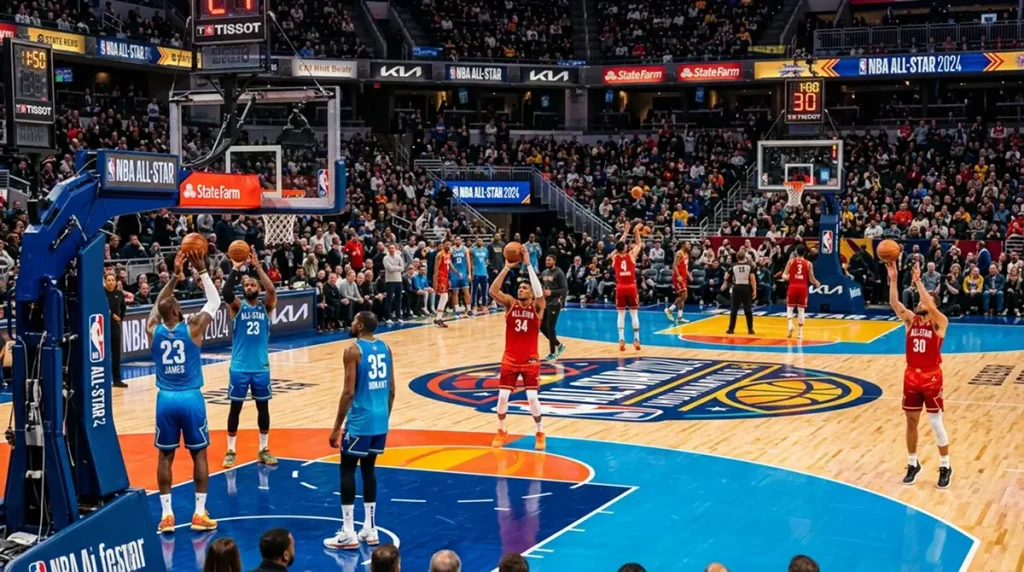
Contents
The All-Star Game Looks Like Basketball — But It Does Not Bet Like Basketball
My worst single-night loss in ten years of NBA betting came on an All-Star Game. Not because the bet was bad on paper, but because I applied regular-season logic to an exhibition event and the market punished me for it. I took the under on a total that sat at 320.5, thinking the number was absurd. The final score was 211-186. Combined: 397 points. I had underestimated how completely the All-Star Game abandons normal basketball dynamics, and I paid for that lesson in full.
The NBA All-Star Game is a mid-season exhibition held in February, featuring the league’s top players selected by fan, player, and media votes. The format has changed multiple times — the current iteration uses a target score in the final period to create a competitive finish — but the fundamental reality remains: this is not a real game. Nobody plays defence in the first three quarters, the pace is artificially elevated, and the total reflects a scoring environment that has nothing in common with the regular season. Betting it requires a completely different framework.
See also NBA odds UK for current market prices.
How All-Star Totals and Spreads Work in Practice
All-Star Game totals are the highest in all of basketball betting. Lines typically open between 310 and 340, compared to regular-season totals of 215 to 235. The inflation reflects the no-defence exhibition reality: possessions are faster, shot selection is worse (more three-point attempts, more flashy dunks, fewer mid-range jumpers), and transition offence dominates because nobody bothers to get back on defence. The scoring rate per possession in the All-Star Game runs 30 to 40 per cent higher than a regular-season game.
Spread betting on the All-Star Game is essentially a coin flip with a margin attached. The rosters are constructed for balance rather than competitive advantage, and the absence of preparation, scouting, and defensive effort means any spread wider than two or three points is mostly noise. I avoid All-Star spreads entirely. The variance is too high, the information set is too thin, and the margin is the same as a regular-season game where you have a genuine analytical edge. The NBA drew 170 million viewers in the US during the 2026-26 season, and the All-Star Game is one of the flagship broadcast events — but viewership does not correlate with betting value.
Player performance markets — individual scoring totals, MVP, and specific statistical achievements — are the only All-Star markets where I see consistent edges. The bookmaker prices these based on regular-season averages, but All-Star performance is driven by minutes played, role in the exhibition, and whether a player is trying to entertain (more scoring attempts) or coasting (fewer minutes, passive play). Understanding which players treat the All-Star Game as a showcase versus which players treat it as a rest day is the key analytical input.
The MVP Market and Why Narrative Drives Pricing
All-Star MVP betting is a narrative market, not an analytical one. The award goes to the player who puts on the most impressive individual performance, which is a function of scoring volume, highlight plays, and the moment in which those plays occur. The target-score format concentrates attention on the final period, which means the player who hits the game-winning shot or dominates the closing minutes has a massive edge in MVP voting regardless of their overall statistics.
Bookmakers price the MVP market based on star power and regular-season performance, which creates systematic mispricings. The most famous player in the game is not necessarily the most motivated to win MVP. Veterans who have won the award before often coast, while younger stars competing in their first or second All-Star Game play with visible hunger. I look for second or third-year All-Stars with something to prove — players who will treat the exhibition like a real game because the spotlight is still novel for them.
The host-city narrative is another pricing factor. Players from the home team or with personal connections to the host city receive a boost in public betting volume, which shortens their MVP odds beyond what the actual probability justifies. If the All-Star Game is in a city where a rising star plays his home games, the bookmaker will shorten his MVP odds to reflect the expected public action, not the expected performance. Fading that narrative — betting against the local favourite at inflated prices — has been profitable for me in four of the last six All-Star Games.
Skills Competitions and Saturday Night Markets
The Three-Point Contest, Slam Dunk Contest, and Skills Challenge take place the night before the main event, and UK bookmakers offer markets on all three. These competitions are the purest form of exhibition betting: small sample sizes, high variance, and outcomes determined by a handful of individual performances under artificial conditions.
The Three-Point Contest is the most analytically tractable of the three. Regular-season three-point percentage, catch-and-shoot percentage, and performance in open-gym settings all provide relevant data. But the competition format — timed rounds with specific rack placements — introduces noise that season-long stats do not capture. Some elite shooters freeze under the timed pressure; others thrive on it. Historical contest performance is the best predictor, which means first-time participants are the hardest to price and therefore the most likely source of mispricings.
The Slam Dunk Contest is pure entertainment and should be bet accordingly. The scoring is subjective (judges award points), the outcomes are heavily influenced by creativity and presentation rather than athletic ability, and the variance is astronomical. I treat Dunk Contest bets as entertainment wagers with a strict maximum stake of two pounds. Any analytical framework applied to a creativity-judged dunking competition is overthinking a fundamentally random event. For structured markets where analysis actually applies, the totals betting framework serves you better than anything the All-Star weekend offers.
See also bets for nba for the complete NBA betting guide.
Fitting All-Star Weekend into Your Seasonal Betting Calendar
The All-Star break falls in the middle of February, and the week-long pause in regular-season play creates a dead zone for standard NBA betting. No games, no spreads, no totals. All-Star weekend is the only action available, and that scarcity drives bettors who would normally skip exhibition events into markets they have no edge on.
My approach: I set a fixed All-Star budget that is entirely separate from my regular NBA bankroll. This budget covers the Three-Point Contest, one or two All-Star Game player markets, and possibly an MVP bet if the narrative creates a clear mispricing. The budget is small — typically the equivalent of two or three regular-season bets — because the expected value is lower and the variance is higher. When the All-Star budget is spent, I stop. The regular season resumes within days, and the real opportunities return with it.
One strategic benefit of the All-Star break that has nothing to do with exhibition betting: the pause is an excellent time to audit your season-to-date results, recalibrate your models, and identify which market types and bet sizes are delivering the best risk-adjusted returns. The NBA’s 82-game regular season is a marathon, and the mid-point break is the natural place to assess whether your process is working or needs adjustment before the second-half push towards the playoffs.
