
NBA Live Streaming and Betting in the UK: Why Watching the Game Changes Everything for In-Play Markets
 Available in US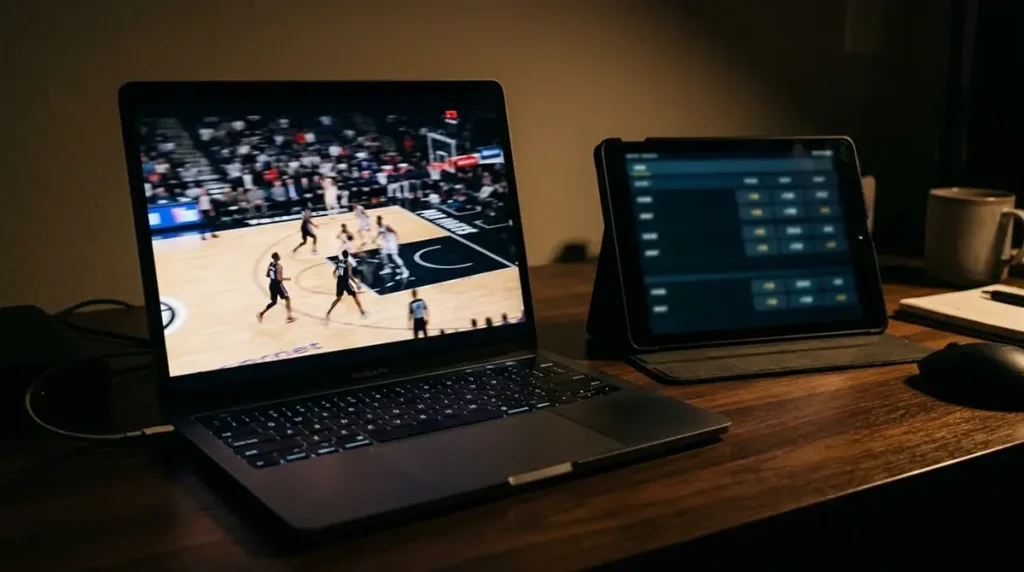
I placed a live under bet during a Nuggets game last December based purely on the numbers scrolling across my sportsbook screen. The score looked like it was running hot, the pace data suggested both teams were pushing, and the live total had climbed to 232.5. I took the under. What I did not see — because I was not watching the game — was that Denver had just lost their starting centre to a turned ankle and switched to a small-ball lineup that would slow the pace dramatically in the second half. The bet hit, but only by accident. If I had been watching, I would have hammered the under with twice the stake and three times the confidence.
That night crystallised something I had been circling around for years: in-play NBA betting without a live stream is like driving with a blindfold. You can feel the road, but you cannot see what is coming. UK punters now have more ways to watch NBA games live than at any point in history, and the gap in results between bettors who watch and bettors who do not is widening every season.
See also US vs UK sports betting market for a broader perspective.
Contents
The UK Streaming Landscape for NBA in 2026
NBA viewership on Amazon Prime Video in the UK surged 312% year on year during the 2026-26 season. That number is not a typo. Prime Video’s deal with the NBA — part of an eleven-year, $6.9 billion media rights package that launched in October 2026 — transformed how British basketball fans consume the sport. Before this deal, watching NBA in the UK meant either an expensive League Pass subscription or hunting for unreliable streams. Now, a Prime membership that most UK households already own for delivery includes live NBA games multiple nights per week.
TNT Sports carries additional NBA coverage in Britain, including marquee national broadcasts and playoff games. NBA League Pass remains the option for completists who want access to every game, though its price point puts it firmly in the dedicated-fan category. Between these three platforms, a UK bettor can watch live NBA action five to seven nights per week during the regular season and every night during the playoffs.
Alex Green, managing director of Prime Video Sport International, noted that record audiences on the platform demonstrated untapped demand for the NBA in Europe, with fans consistently making it part of their weekly sports schedule. For UK bettors, this explosion in accessible coverage changes the in-play betting equation fundamentally.
What You See on a Stream That Numbers Cannot Show
A live box score tells you that a team is shooting 52% from the field. It does not tell you that their shots are heavily contested and falling on luck rather than quality. It does not show you that the opposing coach has switched to a zone defence that is funnelling the ball into the hands of the weakest decision-maker on the court. It does not reveal that a star player is visibly limping but has not been subbed out yet.
I keep a mental checklist of things I watch for during live NBA games that directly inform my in-play betting decisions. Defensive intensity is the first: are both teams contesting every shot, or has one side checked out mentally? Rotation patterns come next: is the coach shortening his bench, which signals he is taking the game seriously, or is he experimenting with unusual lineups, which signals he may be conceding? Foul trouble is the third: a team’s best defender picking up his third foul early in the second quarter changes the entire trajectory of the game in ways the live spread rarely reflects immediately.
The information advantage from watching is most pronounced in the third quarter. NBA third quarters are notoriously volatile — teams come out of the halftime break with adjusted game plans, and the first five minutes of the third often set the tone for the rest of the game. Bettors watching the stream can identify these shifts as they happen. Bettors relying on a scorecard see the effects only after they have already moved the line.
Stream Delay and Its Impact on Live Betting
Every UK streaming platform carries a delay relative to the live broadcast. Prime Video typically runs 15 to 30 seconds behind real-time. TNT Sports is similar. NBA League Pass can lag by up to 45 seconds depending on your connection and device. This delay matters for in-play betting because the sportsbook’s odds are updated based on the real-time feed, not the delayed consumer stream.
In practice, this means the sportsbook knows about a made three-pointer or a turnover before you see it on your screen. If you are trying to place a bet in reaction to something you just watched, you are already behind. I learned this the hard way when I saw a team hit back-to-back threes and rushed to bet the live over, only to find the line had already jumped two points before my bet was accepted.
The workaround is to use the stream for context rather than triggers. I watch the game to understand the flow, the matchups, and the momentum — then I place bets based on patterns I expect to continue, not on events I just witnessed. If I see a team’s defence collapsing over a five-minute stretch, I bet the over for the next quarter based on the defensive trend, not on the specific bucket I just watched go in. This approach turns the delay from a disadvantage into an irrelevance.
Setting Up a Dual-Screen Workflow
My standard setup for NBA live betting nights is a laptop with the sportsbook account and a second screen — usually a tablet or television — showing the game stream. I keep the sportsbook on the laptop because I need to type quickly when placing bets, and the larger screen shows the game because visual detail matters more than text size for watching basketball.
I also run a simple spreadsheet on the laptop that tracks my pre-game predictions against the live action. Before tip-off, I write down my expected total for each quarter, my predicted top scorer, and the matchup I think will be most decisive. As the game unfolds, I compare these predictions to reality. When the game diverges significantly from my pre-game read — the total is running 15 points above my projection after two quarters, for instance — I investigate why and decide whether to act.
This workflow sounds elaborate, but it takes only ten minutes to set up before the game. The pre-game predictions anchor my thinking and prevent me from reacting emotionally to the live action. Without them, it is too easy to get swept up in a run of made threes and chase the over, or to panic when a favourite falls behind early and hedge a position unnecessarily.
Which Games to Watch and Which to Skip
NBA tip-off times for UK punters range from 11 PM to 3:30 AM GMT on most nights, with weekend matinees occasionally starting at 8 PM or 9 PM. Watching every game is impossible and counterproductive. I select one or two games per night based on three criteria: do I have a pre-game bet on this matchup, is the game likely to be competitive enough for in-play opportunities, and does my research suggest a specific angle that the stream would help me evaluate?
The last criterion matters most. If my angle is purely statistical — an over bet driven by pace projections — watching the game adds less value because the stats will tell me what I need to know. But if my angle involves a specific player matchup, a coaching adjustment, or an injury concern, the stream is essential. The UK remote betting market generates around GBP 2.4 billion annually in gross gambling yield, and the punters who extract the most value from that market are the ones who watch selectively rather than obsessively.
I also prioritise games involving teams I follow closely. Familiarity with a team’s tendencies, bench rotations, and coaching patterns makes the information I gather from the stream far more actionable. Watching a random game between two teams I rarely follow is entertaining but gives me less of an edge than watching a team I have studied for months.
See also bets for nba for the complete NBA betting guide.
When the Stream Tells You to Walk Away
The best live-betting decision I make most nights is the decision not to bet. Watching the game sometimes reveals that neither team is playing with intensity, or that the game script is too chaotic to predict, or that an injury has scrambled the rotations beyond what any model can handle. In those moments, the stream’s value is not in identifying a bet — it is in keeping me away from a bad one.
Late-night NBA sessions are particularly dangerous for UK bettors because fatigue erodes discipline. I set a hard stop time of 2:30 AM on weeknights, regardless of how the game is going. If the stream is showing me something interesting but it is past my cutoff, I note it for future reference and close the laptop. The NBA plays every night. There will always be another game, another angle, another opportunity. The stream is a tool, not a trap — as long as you decide when to turn it off.
